Atlas to the root system drawings: https://bit.ly/30fjrhH
Soil multitrophic network complexity enhances the link between biodiversity and multifunctionality in agricultural systems
Jiao et al., 2021
Belowground biodiversity supports multiple ecosystem functions and services that humans rely on. However, there is a dearth of studies exploring the determinants of the biodiversity–ecosystem function (BEF) relationships, particularly in intensely managed agricultural ecosystems. Here, we reported significant and positive relationships between soil biodiversity of multiple organism groups and multiple ecosystem functions in 228 agricultural fields, relating to crop yield, nutrient provisioning, element cycling, and pathogen control. The relationships were influenced by the types of organisms, that soil phylotypes with larger sizes or at higher trophic levels, e.g., invertebrates or protist predators, appeared to exhibit weaker or no BEF relationships when compared to those with smaller sizes or at lower trophic levels, e.g. archaea, bacteria, fungi, and protist phototrophs. Particularly, we highlighted the role of soil network complexity, reflected by co-occurrence patterns among multitrophic-level organisms, in enhancing the link between soil biodiversity and ecosystem functions. Our results represent a significant advance in forecasting the impacts of belowground multitrophic organisms on ecosystem functions in agricultural systems, and suggest that soil multitrophic network complexity should be considered a key factor in enhancing ecosystem productivity and sustainability under land-use intensification.

https://onlinelibrary.wiley.com/doi/10.1111/gcb.15917
.
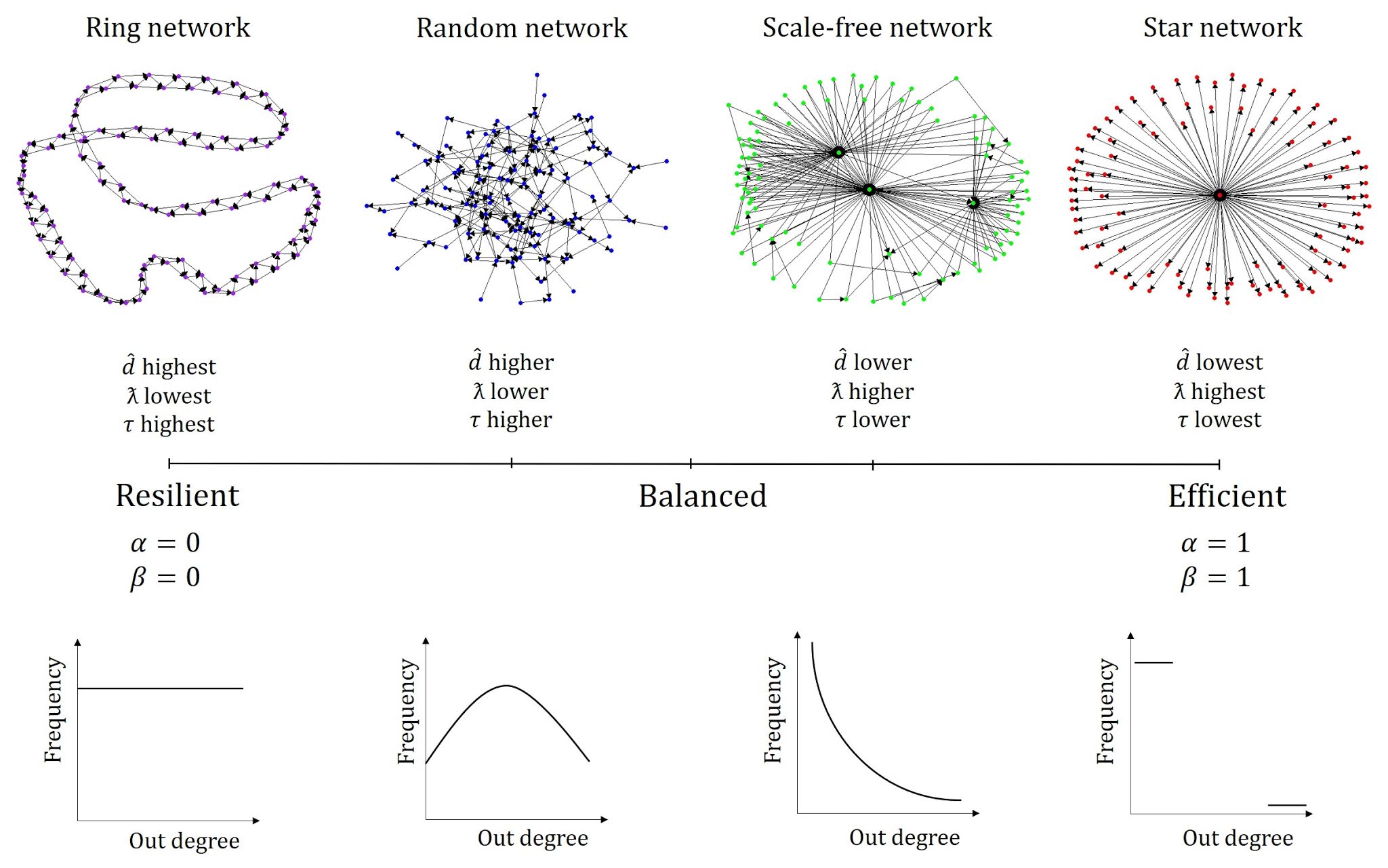
A complex network framework for the efficiency and resilience trade-off in global food trade
Deniz Berfin Karakoc and Megan Konar, 2021
Global food trade is crucial for food security and availability. Trade is typically optimized to promote efficiency, whereas resilience is increasingly being recognized as another important objective. However, it is not clear if prioritizing resilience comes at the expense of efficiency or if the two objectives can be promoted simultaneously. We develop a complex network framework to assess the relationship between resilience and efficiency of food trade for the last half century. There is a competitive relationship between efficiency and resilience when only network topology is considered. However, a cooperative relationship between efficiency and resilience exists when the intensity of trade connections is accounted for. Policy makers can use this framework to evaluate the relationship between efficiency and resilience in critical supply chains.
.
Plant defence to sequential attack is adapted to prevalent herbivores
Mertens tal., 2021
Plants have evolved plastic defence strategies to deal with the uncertainty of when, by which species and in which order attack by herbivores will take place. However, the responses to current herbivore attack may come with a cost of compromising resistance to other, later arriving herbivores. Due to antagonistic cross-talk between physiological regulation of plant resistance to phloem-feeding and leaf-chewing herbivores, the feeding guild of the initial herbivore is considered to be the primary factor determining whether resistance to subsequent attack is compromised. We show that, by investigating 90 pairwise insect–herbivore interactions among ten different herbivore species, resistance of the annual plant Brassica nigra to a later arriving herbivore species is not explained by feeding guild of the initial attacker. Instead, the prevalence of herbivore species that arrive on induced plants as approximated by three years of season-long insect community assessments in the field explained cross-resistance. Plants maintained resistance to prevalent herbivores in common patterns of herbivore arrival and compromises in resistance especially occurred for rare patterns of herbivore attack. We conclude that plants tailor induced defence strategies to deal with common patterns of sequential herbivore attack and anticipate arrival of the most prevalent herbivores.