domingo, 31 de marzo de 2019


sábado, 30 de marzo de 2019
viernes, 29 de marzo de 2019
Cascading regime shifts within and across scales
Rocha et al.


Rocha et al.
Regime shifts are large, abrupt and persistent critical transitions in the function and structure of systems. Yet it is largely unknown how these transitions will interact, whether the occurrence of one will increase the likelihood of another, or simply correlate at distant places. Here we explore two types of cascading effects: domino effects create one-way dependencies, while hidden feedbacks produce two-way interactions; and compare them with the control case of driver sharing which can induce correlations. Using 30 regime shifts described as networks, we show that 45% of the pair-wise combinations of regime shifts present at least one plausible structural interdependence. Driver sharing is more common in aquatic systems, while hidden feedbacks are more commonly found in terrestrial and Earth systems tipping points. The likelihood of cascading effects depends on cross-scale interactions, but differs for each cascading effect type. Regime shifts should not be studied in isolation: instead, methods and data collection should account for potential teleconnections.

Minimal examples of the cascading effects. We merged pairs of regime shifts causal networks and created a response variable matrix that accounted for drivers shared, domino effects, or hidden feedbacks for all pair-wise combinations of regime shifts. For example, for drivers sharing two minimal regime shifts are depicted as causal diagrams, drivers are coloured red and variables inside feedbacks purple. The joint network is represented as a 2-mode network which allows us to study the co-occurrence of drivers across regime shifts. The response variable matrix counts the drivers shared by all pair-wise combinations of regime shifts. In the example of a domino effect two regime shifts are joined together where driver c in regime shift 2 is part of a feedback process in regime shift 1, creating a one-way dependency (orange colored link) between the two regime shifts. The response variable matrix counts all the one-way causal pathways between pair-wise combinations of regime shifts. In the example of a hidden feedback, two minimal regime shifts when joined together give rise to a new unidentified feedback of length 4 (orange circular pathway). The response variable matrix counts all hidden feedbacks that arise when merging all pair-wise combinations of regime shifts. Labelled matrices of the resulting response variables are available in the supplementary material.

Driver sharing. The distribution of drivers shared per regime shift (a) with respect to the number of drivers each one has (black points) shows that regime shifts in aquatic environments tend to have and share more drivers. (b) shows the drivers most shared. WAIS abbreviates West Antarctica Ice Sheet collapse.
.
jueves, 28 de marzo de 2019

miércoles, 27 de marzo de 2019

domingo, 24 de marzo de 2019
Microbial interkingdom interactions in roots promote arabidopsis survival
Durán et al., 2019
Plant roots are associated with highly structured microbial communities
composed of bacteria, fungi, and oomycetes. How these microbes interact
to influence plant health has remained poorly studied. Although it is
generally believed that a balanced soil microbial community is critical,
how different components of the community influence each other and how
they influence plant health are unknown. The study led by Schulze-Lefert
and Stéphane Hacquard investigated microbial community structures of
three natural populations of Arabidopsis from different geographical
locations. They conducted profiling analyses of relative abundance and
operational taxonomic units (OTUs) of root-associated bacteria, fungi,
and oomycetes, and investigated intra- and inter-kingdom relationships
of the communities. These uncovered a striking difference between
inter-kingdom and intra-kingdom interactions. While the bacterial-fungal
interactions were predominantly negative, the bacterial and fungal
intra-kingdom interactions were predominantly positive.
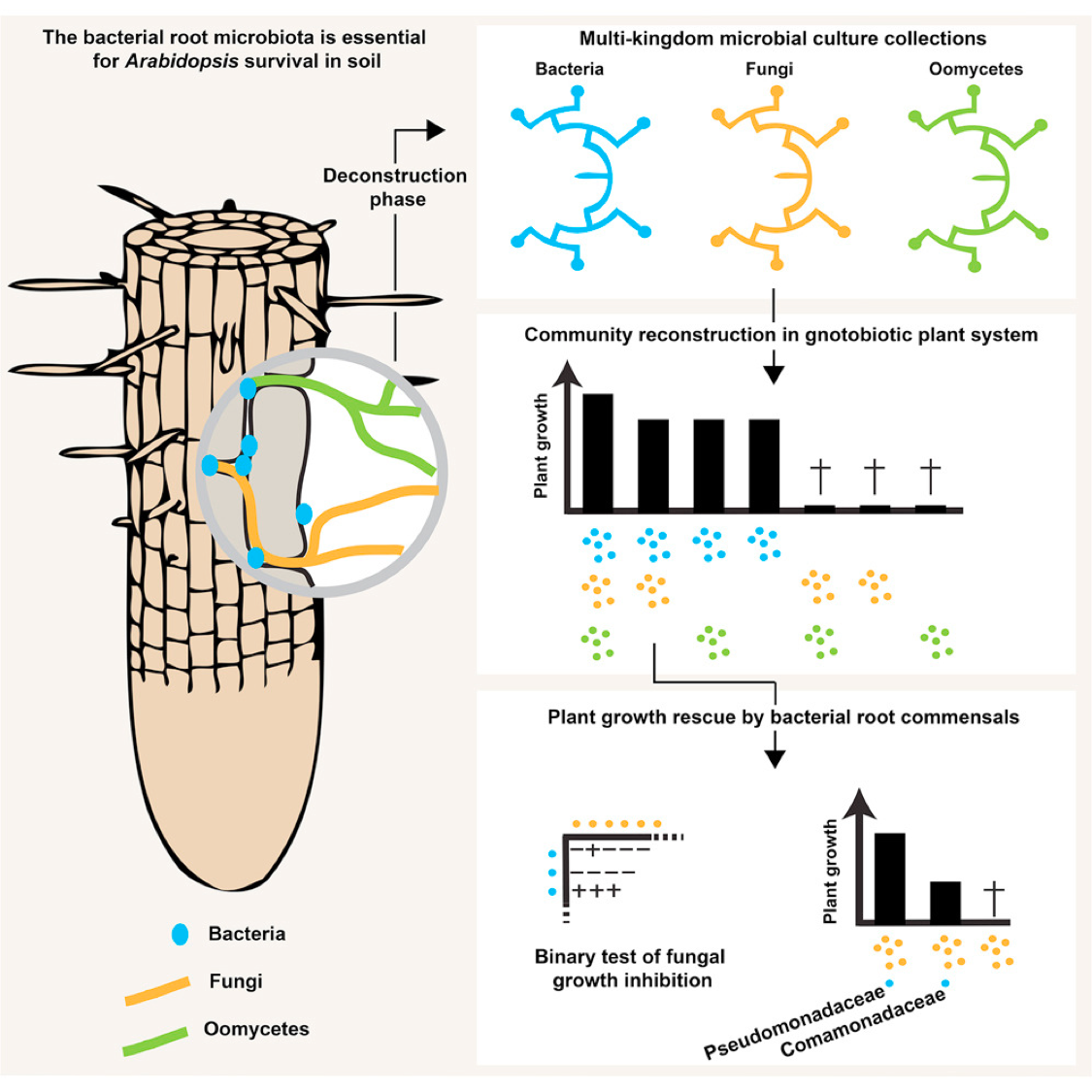
To experimentally determine how the bacterial community interacts with fungal and oomycetal communities, the authors established culture collections covering significant proportions of the observed OTUs of bacteria, fungi, and oomycetes. They then adopted a gnotobiotic system to reconstitute microbial communities, so that they can determine impact of different communities on plant health and influence between different communities. Strikingly, they found that inoculation of sterile soil with a fungal or oomycetal community in the absence of bacteria led to low to zero survival rates of plants, indicating detrimental effects of fungal and oomycetal communities on plant health. In contrast, the addition of bacterial community provided not only positive growth benefits to Arabidopsis plants, but also full protection against fungi and oomycetes. As a large proportion of these fungi and oomycetes are plant pathogens, the results indicate that the plant immune system is unable to defend against these pathogens and that the root-associated bacterial community plays a decisive role in protecting plants from these pathogens. Consistent with observations from natural communities, the synthetic bacterial community had a large negative effect on fungal and oomycetal communities.
Pair-wise interaction analyses of individual bacterial strains on fungal growth showed that Comamonadaceae and Pseudomonadaceae had greatest antagonistic effects against diverse fungal isolates. Depletion of these two groups of bacteria from the synthetic community resulted in reduced protection against fungi. However, this Comamonadaceae- and Pseudomonadaceae-depleted bacterial community still provided profound protection against the fungal community in the gnotobiotic system, indicating that plant health protection against fungal pathogens is a highly redundant function in commensal bacteria. Together, this study advances our understanding of inter-kingdom interactions in root-associated microbial communities and provides much needed insights into the role of microbial community in plant health. The successful application of a gnotobiotic system and synthetic communities opens up new horizons for plant immunity studies and development of better biocontrol agents.
.
viernes, 22 de marzo de 2019
Corn Face

Vascular bundle of a Zea mays (corn) stem as seen through
the microscope. The 'eyes' and 'nose' of the face are large vessels that
transport water and minerals to the leaves.
Photo: Olivier Leroux
jueves, 21 de marzo de 2019
Interactive map to explore links between where food crops come from, their native origins, traditional regions of diversity and where
they are now eaten worldwide

martes, 19 de marzo de 2019
Map showing the rapid spread of potato late-blight in the 1840s
In just 3 months, this crop disease spread from Belgium down to Spain, across to Ireland and up to Norway (all in an age before motorized transport)
 @2blades
.
In just 3 months, this crop disease spread from Belgium down to Spain, across to Ireland and up to Norway (all in an age before motorized transport)

.
lunes, 18 de marzo de 2019


By Britton, Nathaniel Lord (1859-1934)
https://bit.ly/2F4shBc
.
Suscribirse a:
Entradas (Atom)